Agree directly
with another network.
The two operators agree their BGP session and the routes they exchange. Each network applies its own policies.
Independent networks. New connections. Talk to our NOC
THE PEERING GUIDE
An exchange, a transit service and a tunnel solve different problems. Here is how they fit together—and why the distinction matters.
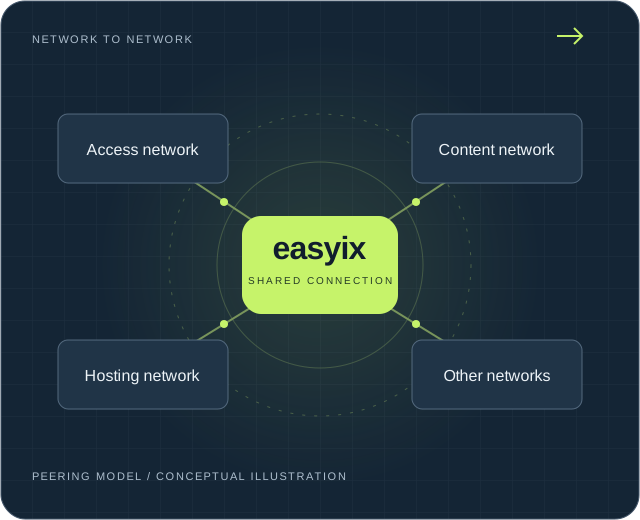
NETWORK TO NETWORK
Peering is an agreement between networks to exchange particular routes and traffic.
A shared exchange makes those network relationships possible over common interconnection infrastructure. It does not automatically give you every Internet route or a peering relationship with every participant.
THREE DIFFERENT JOBS
Start with the outcome you need. Access and service availability must be confirmed for your connection.
| Arrangement | What it does | What to agree |
|---|---|---|
| Exchange peering | Exchanges agreed routes with other participating networks. | Access, peer relationships, session parameters and routing policy. |
| IP transit | Provides wider Internet reachability through an upstream arrangement. | Offered routes, accepted announcements, delivery and commercial terms. |
| Tunnel transport | Carries traffic over an existing IP connection. | Endpoints, protocol, addressing, MTU and the service carried through it. |
PEERING RELATIONSHIPS
The two operators agree their BGP session and the routes they exchange. Each network applies its own policies.
A route server can distribute routing information between participants who use it. Eligibility, filtering and session settings depend on the exchange’s published arrangements.
These describe peering models. Confirm EasyIX route-server availability and parameters with our NOC; no exchange route-server configuration is supplied here.
A FEW USEFUL TERMS
EXPLORE EASYIX
Visit the separate EasyIX portal for current availability and member access.